ASHLEY SCOTT KELLY
Urban Found Architecture
Hong Kong
ashley@urbanfoundarch.com

BIO

PROJECTS:


CLIMATE CHANGE &
COOPERATIVE ACTION
Counterpart Cities, PRD, China 2011
 
With the University of Hong Kong.
Terence Riley, Jonathan Solomon, Dorothy Tang (Curators);
Ashley Scott Kelly (Research Associate);
M Berlinrut, CH Chan, CW Fok, Q Zhang (Research Team);
Milkxhake (Graphic Design).
www.counterpartcities.org
 
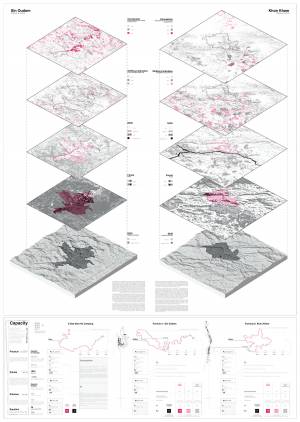
Led by a curatorial team from the University of Hong Kong, the work suggests the collaboration of regional resources given impetus and/ or affected by climate change:  Climate change as opportunity.  Alongside wide-ranging research introducing the complexity of the region through the lens of major natural and man-made infrastructures, three design teams from Hong Kong and three from Shenzhen exhibit their visions for the regional cooperation of ports, freshwater delivery systems and cross-border ecologies.
 
Exhibited: 2011 Shenzhen & Hong Kong Bi-city Biennale of Urbanism/ Architecture

PROJECTS:


AESTHETICS, RISK AND JUSTICE
Housing the Migration Corridor 2011
 
Considering current places of industrialization, specifically China, there is a new emergent type coming into the profession, thinking of recent commissions for Morphosis and Diller, Scofidio + Renfro to create what are essentially factory-campuses, the 21st century, capitalist equivalent of the Chinese danwei.  Using comparative research on New York and Hong Kong-Shenzhen, this project aims to establish a program for and analyses on the possibility of embedding a new factory-town type into the post-industrial city.  Formally, the work is an exploration of limits and deviation from the necessary economies of both social housing and light industry, and the negotiation of their scalar differences at high densities.  It positions a model that can raise awareness across a very horizontal set of architectural and ethical goals, to reacquaint us with both industry, and the 'other.'

PROJECTS:


SPECULATION I
Chongqing Museum 2010
 
Architecture that operates at the urban scale generally attempts to dissolve.  The project seeks to find a particular language for the museum that is able to conform to a nearly infinite range of site dimensions and topographic conditions, linking high and low ground.  The building is parametrically generated in CATIA by a 'best fit' algorithm, placing program throughout the structure based on its proximity to defined program attractors, distributing and re-distributing in the available space.  Alternating voids, projected normal to the ground, are cut through the building to force linear circulation through the galleries.  Two sites were chosen with drastically different site areas and proportions, producing a tower and pseudo-mat typology that are formally geologic in their stratification and registration of Chongqing's highly varied topography.

PROJECTS:


BROOKLYN FOUNDRY
Atlantic-Vanderbilt Yards 2009
 
The project registers a new visible public infrastructure to foster the distributions, collections and expansion necessary to sustainably re-diversify the City's land uses.  The hyperdense structure creates a highly-differentiated cross-grain, traversed by multiple, focused public grounds that look to reorganize the collision between mega(infra)structural planning and a society of private ownership.

PROJECTS:


GALLERY DIALECTIC
Primary School Ann Arbor 2005
 
This early proposal is for a primary school granted land within the parking lot of an existing nature preserve.  The school is anchored at one end by a multipurpose gym and lap pool, wedged within a northern concrete wall, and at the other end the administrative office.  A constant, easily understood and navigable sectional parti organizes the building, with slight angular variations that create difference and programmable residual space for classroom exhibit and storage.  The building runs perpendicular to the slope so that the structure is lowest near the entrance drive, preserving canopy views, while shielding the park from high-traffic areas.  Internally, this grade change raises the classrooms six feet above the forest floor to allow the vertical curtain wall to interact with the field of trees.  The linear arrangement of interconnected classrooms and pseudo-open plan dispels with classroom hierarchies and allows for the reorganization of notably rigid educational systems.

PROJECTS:


BAMBOO GROWTH ECONOMY
LeKinkeliba Foundation Senegal 2009
 
Due to high seasonal climate variation and its influence on regional worker patterns, the project aims to stem rural-urban migration and the exodus of Senegalese youth to Europe through the teaching of dry-season agro-forestry techniques and economies.  The growth of bamboo clumps within the colony, as well as the landscape of production and harvesting is adapted to passively provide shade and wind-break to buildings and people.  Basic necessities of water, shade and shelter organize the colony into clusters not dissimilar from the traditional African village, while redefining its aesthetic character based on the means of felling, curing and drying of this native African species of bamboo.
 
Exhibited: Shown via studioplex.org at the 2010 Venice Biennale
Published: Selected for Harvard's StudioWorks 2010

PROJECTS:


PROSPECT ON STRUCTURE
Grand Army Plaza 2008
 
The call to reinvent the face of Prospect Park's 526 acres of forest, water and wetlands is to signal a new public attitude with the extension of the park's ecological systems and interface with the City, creating a multifaceted network of open space, transit and cultural exchange.
 
Awards: Honorable Mention Reinventing Grand Army Plaza Competition
Exhibited: Design Trust for Public Space Exhibition Brooklyn 2008
Published: Reinventing Grand Army Plaza 2009

PROJECTS:


MAPPING THE ECOTONE
Gateway NRA Revitalization 2007
 
Collaboration with R Wakabayashi.
This project creates a highly visible, experiential public infrastructure that responds to the shifting ecosystem of Jamaica Bay and defines a new vision of the relationship between nature and people.  Though within New York City, it is a stretch to call this an urban park in the context of Manhattan.  Gateway must be made more accessible in terms of its idea.
 
Awards: First Prize Van Alen Inst Envisioning Gateway Competition 2007
Published: 1000x Landscape Architecture; LA Journal China; others

PROJECTS:


DIFFUSE DENSITY
Detroit Brownfield 2006
 
The project proposes a sustainable market-based urban forest and wetland development model to restitch three communities south of Detroit separated by an 87 acre industrial brownfield.
"The ecological analyst faces a dilemma: on the one hand... he must first recommend whatever will give the system a positive budget of flexibility; and on the other hand the people and institutions with which he must deal have a natural propensity to eat up all available flexibility. He must create flexibility and prevent the civilization from immediately expanding into it." - Gregory Bateson
 
Published: Michigan's Dimensions20 2007

PROJECTS:


BASIC LINEAR LIMITS
Structural Approximation 2010
 
Collaboration with M Puig & Y Inamoto.
This work is a look back into scripting from the bottom of the technological pyramid.  It is a similar exploration as with many of my projects in its inquiry of authorship, default, conceptual linearity, approximation and flexibility.
The project works under the following parameters and basic assumptions:
1) Any shape, any solid.  The user inputs any 2D shape touching the four cardinal points, and then defines a bounding solid into which it propagates.
2) Orthogonality.  The project defaults to the orthogonality of the coordinate system.  The shape panels connect at 90 degrees in order to create the simplest friction joint possible.
3) Continuity, linear assembly and density.  The propagation creates a linear, orthogonal path, imprinted on the panels with assembly numbers, until it is either stopped or is unable to continue.  New paths can be started until the desired structural density is achieved.
4) Self-aware and recombinatory.  These paths, if near, will choose to recombine for increased structural rigidity and mark each recombination with an (!) point, allowing the user to judge the form's overall stability.  The program, even if stopped, will remember the achieved configuration and continue to build upon it.
5) Asymptotic approximation.  As the paths meander, the shape panels are scaled asymptotically relative to the bounding solid: The closer they come to the bounding solid, the smaller the panels, and hence the bounding solid's form is approximated with higher resolution.
6) Global deformation.  The project began towards its end also to globally deform, through mathematical equations, the matrix within which the panels propagate, beginning to escape the orthogonal rigidity supposed earlier.

PROJECTS:


MOBILE PARAISOPOLIS
Brazil Mobile Commodity Market 2010
 
Collaboration with S Corriel.
Informal interventions typically create new modes of entrepreneurship without understanding the logistics of existing informal capital flows, largely between divergent and imminently juxtaposed income groups.  Are there possible sources of capital for physically retrofitting slums from within these economies, and can there be increased community ownership of physical improvements when funded by these processes?  "[In Planet of Slums,] Davis finds that... employment in the informal sector is not generated primarily through new initiatives but by dividing existing jobs and incomes."
Paraisopolis has been a laboratory for extensive mapping and census efforts by both the Brazilian government and NGOs.  Referencing precedent successes and failures of earlier projects, this work proposes to pilot an icon-based mobile yellow-pages platform linked to a particular industry with wide environmental and social benefit.
The settlement, at any given moment, can be understood to be about 50% under construction and is 90% masonry.  In order to decrease mass construction waste and the high price of materials, and increase local availability, a mobile commodity pricing and yellow-pages platform allows suppliers to market their goods in bulk with a cooperative of Paraisopolis material shop owners.  This location-specific, distributed platform further allows contractors and property owners to source locally from a new dispersed array of material stockpiles, creates new jobs and facilitates a full-circle waste recovery cycle.

PROJECTS:


GLOBAL EQUATORIAL INDUSTRIES
Latin & Sub-Saharan Flower Trade 2010
 
With Somatic Collaborative.
This study maps the distribution of greenhouses in four high-altitude regions:  Bogota-Madrid, Quito-Cayambe, Addis Ababa-Oromia, and Nairobi-Naivasha.  Supported by their adjacency to state capital infrastructure, these locations deliver most of the world's flower market while heavily polluting regional water supplies and subjecting worker's health to high levels of pesticides.

PROJECTS:


ARID GROUND/ SUBFLOW
Arizona Regional Water 2009
 
Continued over-pumping of groundwater and diversion of the region's surficial flows has caused more than 3000 square miles of Arizona to experience some form of differential land subsidence.  Rapid population growth is increasingly juxtaposing urban densities with tensile earth fissures, pulling at the basins' edge.  Land use in the region will need to adapt radically to new systems of water conveyance, use and storage.  Climate modeling indicates the desert southwest will be particularly hard hit by global warming, with longer droughts and more extremes in rainfall.  A change in the ground's makeup may very well alter the policies and capitalist politics of private property, immanently establishing a new geography for the region.

PROJECTS:


TRANSMISSION LANDSCAPES
L.A. Energy Infrastructure 2009
 
Though the system has strength in its effective distribution of massive amounts of power to the entire Los Angeles metropolitan region, 'weak' energy can be defined in terms of more ad-hoc planning arrangements within and on the city's periphery where natural processes have the ability to interact, damage and possibly benefit the system.  The notorious yearly brush fires in the Los Angeles National Forest and the modified, artificial 'burn-cycle' of this landscape, the 1994 Northridge Earthquake, drought and the disproportionately high hydroelectric capacity of the California Aquaduct's Castaic terminus, underground pumps and artificial natural gas reservoirs are just a few examples of those opportunistic points of operation.  In studying these points, one can begin to approximate the infrastructural 'maxima and minima' of the system under very precise environmental loads.


FILE TRANSFER

Instructions:  Enter client ID and submit at right to log in.  Only standard image, office, and zip files may be uploaded.  For all other file types, please package them in a .zip archive prior to uploading.  File size is limited to less than 400 MB.  Adobe Flash Player 9.0 or higher required.
 
Click refresh to view updated directory contents.


The content and design of this website is copyright © 2005-2012 Ashley Scott Kelly, unless authorship is otherwise noted. Reproduction in any media of any content, images, code, text or related intellectual property is prohibited without written permission from the author.
ASHLEY SCOTT KELLY
pause/resume
 
 
Loading video...


LOADING...
Hello,
 
This site is the design work and research of Ashley Scott Kelly.  I take an attitude that most complex problems can be advanced and mediated through design, using a wide consideration of urban processes, economy, ecologies and social observations.  My work is largely an attempt to register at a human scale the imperatives, and unique alternatives, for a given time and context:  From the long-span effects of climate change in New York's Gateway National Park, to the use of different growth-stages of bamboo as structure, income and for generating community for an NGO in rural Senegal.
 
My ongoing research compares the histories of industrialization and modernization, notably of New York, Hong Kong and the greater Pearl River Delta, with a focus on environmental risk and policy, equity, aesthetics and the distribution of physical resources.  I have experience working directly with clients, city agencies and developers, to produce schematic plans of city transit infrastructure, architecture and urban design in both developed and developing economies.


07 December 2011   Counterpart Cities: Climate Change and Collaborative Action in Hong Kong & Shenzhen opens today at the Shenzhen & Hong Kong Bi-City Biennale of Urbanism/ Architecture.  For directions to the exhibition site, OCT Loft B10, visit www.szhkbiennale.com.  For project information, visit the new Counterpart Cities website www.counterpartcities.org.
 
26 October 2011   Counterpart Cities: Climate Change and Collaborative Action in Hong Kong & Shenzhen will open at the Shenzhen & Hong Kong Bi-City Biennale of Urbanism/ Architecture on December 8th.  Led by a curatorial team from the University of Hong Kong, the work suggests the collaboration of regional resources given impetus and/ or affected by climate change:  Climate change as opportunity.  Alongside wide-ranging research introducing the complexity of the region through the lens of major natural and man-made infrastructures, three design teams from Hong Kong and three from Shenzhen will exhibit their visions for the regional cooperation of ports, freshwater delivery systems and cross-border ecologies.  The project will also be exhibited in Hong Kong in Spring 2012.
 
06 March 2011   After 4 years and parallel with Senator Schumer's Blue Ribbon Panel for New York's Gateway National Park, Gateway: Visions for an Urban National Park, ed. Alexander Brash, Jamie Hand, and Kate Orff, will be published by Princeton Architectural Press later this year.
 
30 January 2011   Uploaded a brief preview of recent research work, Aesthetics, Risk and Justice: Social Housing for the Migration Corridor.  "Using comparative research on New York and Hong Kong-Shenzhen, this project aims to establish a program for and analyses on the possibility of embedding a new factory-town type into the post-industrial city."
View Project
 
26 August 2010   African Bamboo Growth Economy selected for exhibition via studioplex.org at the 2010 Venice Biennale.
 
20 May 2010   Proposal for multiple museums in Chongqing, China uploaded (with video).
View Project


COUNTERPART CITIES OPENS
07 December 2011
 
Counterpart Cities: Climate Change and Collaborative Action in Hong Kong & Shenzhen opens today at the Shenzhen & Hong Kong Bi-City Biennale of Urbanism/ Architecture.  For directions to the exhibition site, OCT Loft B10, visit www.szhkbiennale.com.  For project information, visit the new Counterpart Cities website www.counterpartcities.org.
 
Counterpart Cities


_________________________________________

COUNTERPART CITIES
26 October 2011
 
Counterpart Cities: Climate Change and Collaborative Action in Hong Kong & Shenzhen will open at the Shenzhen & Hong Kong Bi-City Biennale of Urbanism/ Architecture on December 8th.  Led by a curatorial team from the University of Hong Kong, the work suggests the collaboration of regional resources given impetus and/ or affected by climate change:  Climate change as opportunity.  Alongside wide-ranging research introducing the complexity of the region through the lens of major natural and man-made infrastructures, three design teams from Hong Kong and three from Shenzhen will exhibit their visions for the regional cooperation of ports, freshwater delivery systems and cross-border ecologies.  The project will also be exhibited in Hong Kong in Spring 2012.
 
Design's primary role in these projects, especially for the ports and freshwater distribution systems, is not its effect on logistics or physical operations, but instead its capacity to register the political-cultural differences between Hong Kong and Shenzhen; not so they can be merged, but rather maintain and engender unique characteristics while increasing social and/or political and economic productivity.
 
Projections are not concrete predictions but an instrument of risk that can induce greater change.  Instead of merely technical approaches that focus on prevention, design has the additional capacity to foresee and prepare, organize complex systems and mark the necessity of delivering these projects to the public, whether the actual projection occurs or not.  Sea-level rise is the general measure to which most of the issues are attributed.  We must remember that it is both tangible because it is given measure, somewhat symbolically a quantification of the risk associated with regional inundation, but also intangible for its long time-span, gradual nature.
 
Counterpart Cities


_________________________________________

PRINCETON TO PUBLISH GATEWAY
06 March 2011
 
After 4 years and parallel with Senator Schumer's Blue Ribbon Panel for New York's Gateway National Park, Gateway: Visions for an Urban National Park, ed. Alexander Brash, Jamie Hand, and Kate Orff, will be published by Princeton Architectural Press later this year.


_________________________________________

AESTHETICS, RISK AND JUSTICE DRAFT
30 January 2011
 
Uploaded a brief preview of recent research work, Aesthetics, Risk and Justice: Social Housing for the Migration Corridor.  "Using comparative research on New York and Hong Kong-Shenzhen, this project aims to establish a program for and analyses on the possibility of embedding a new factory-town type into the post-industrial city."
View Project
 
"Considering current places of industrialization, specifically China, there is a new emergent type coming into the profession, thinking of recent commissions for Morphosis and Diller, Scofidio + Renfro to create what are essentially factory-campuses, the 21st century, capitalist equivalent of the Chinese danwei.  Formally, the work is an exploration of limits and deviation from the necessary economies of both social housing and light industry, and the negotiation of their scalar differences at high densities.  It positions a model that can raise awareness across a very horizontal set of architectural and ethical goals, to reacquaint us with both industry, and the 'other.'"


_________________________________________

BAMBOO ECONOMY IN VENICE
26 August 2010


_________________________________________

CHONGQING MUSEUM
20 May 2010
 
Proposal for multiple museums in Chongqing, China uploaded (with video).
View Project
 
"Architecture that operates at the urban scale generally attempts to dissolve.  The project seeks to find a particular language for the museum that is able to conform to a nearly infinite range of site dimensions and topographic conditions, linking high and low ground.  The building is parametrically generated in CATIA by a 'best fit' algorithm, placing program throughout the structure based on its proximity to defined program attractors, distributing and re-distributing in the available space.  Alternating voids, projected normal to the ground, are cut through the building to force linear circulation through the galleries.  Two sites were chosen with drastically different site areas and proportions, producing a tower and pseudo-mat typology that are formally geologic in their stratification and registration of Chongqing's highly varied topography."


_________________________________________

MOYNIHAN UPDATE
23 February 2010
 
Moynihan Station receives stimulus funds to begin phase one development of the Farley Post Office Building.  NY Times


_________________________________________

BAMBOO GROWTH ECONOMY @ WEF
30 January 2010
 
African Bamboo Growth Economy, a project for Le Kinkeliba Foundation, presented by architect Toshiko Mori at the World Economic Forum's IdeasLab on community healthcare.
View World Economic Forum Video   View Project
 
"Due to high seasonal climate variation and its influence on regional worker patterns, the project aims to stem rural-urban migration and the exodus of Senegalese youth to Europe through the teaching of dry-season agro-forestry techniques and economies.  The growth of bamboo clumps within the colony, as well as the landscape of production and harvesting is adapted to passively provide shade and wind-break to buildings and people.  Basic necessities of water, shade and shelter organize the colony into clusters not dissimilar from the traditional African village, while redefining its aesthetic character based on the means of felling, curing and drying of this native African species of bamboo."


_________________________________________

DESIGN TRUST PUBLISHES GAP
15 November 2009
 
Entry for Reinventing Grand Army Plaza (Honorable Mention) published by the Design Trust for Public Space.  Visit the Design Trust's Publications to order or to download a free copy.


_________________________________________

DESIGN ECOLOGIES AND ON THE WATER: PALISADE BAY
04 November 2009
 
UFA's work referenced in Design Ecologies: Sustainable Potentials in Architecture by Lisa Tilder and Beth Blostein, and also in On the Water: Palisade Bay by Guy Nordenson, Catherine Seavitt and Adam Yarinsky.


_________________________________________

ATLANTIC YARDS PROPOSAL
12 May 2009
 
Proposal for Atlantic Yards uploaded.
View Project
 
"The project registers a new visible public infrastructure to foster the distributions, collections and expansion necessary to sustainably re-diversify the City's land uses.  The hyperdense structure creates a highly-differentiated cross-grain, traversed by multiple, focused public grounds that look to reorganize the collision between mega(infra)structural planning and a society of private ownership."


_________________________________________

GATEWAY IN 1000x LANDSCAPE ARCHITECTURE
25 December 2008
 
UFA's work included in 1000x Landscape Architecture published by Verlagshaus-Braun.


_________________________________________

HONORABLE MENTION GRAND ARMY PLAZA
17 July 2008
 
Entry "Prospect on Structure" for the Design Trust's Reinventing Grand Army Plaza competition will be one of thirty exhibited in an outdoor installation within Brooklyn's historic plaza from 12 Sept 2008 through 13 Oct 2008.
 
"The call to reinvent the face of Prospect Park's 526 acres of forest, water and wetlands is to signal a new public attitude with the extension of the park's ecological systems and interface with the City, creating a multifaceted network of open space, transit and cultural exchange."
 
Exhibition Photos 13 September 08


_________________________________________

GATEWAY PUBLISHED
25 December 2007
 
Article written on Gateway published in Landscape Archictecture Journal China, as well as featured in The Architect's Newspaper, Newsday, NY Daily News, am New York, New York Metro, and shown on Fuji TV in Japan.
View Gateway Presentation Video


_________________________________________

FIRST PRIZE VAI ENVISIONING GATEWAY
04 June 2007
 
Mapping the Ecotone selected FIRST PRIZE entry in international design competition Envisioning Gateway for the revitalization of a 26 000 acre national park along NYC's waterfront.
 
 
Ashley Scott Kelly, along with former University of Michigan studio-mate Rikako Wakabayashi, recently won first prize in an international design competition for a vision to revitalize a 26,000 acre national park along New York City's waterfront.  The Gateway National Recreation Area, encompassing Jamaica Bay and parts of the greater NY Harbor, is in a state of disrepair, plagued by vanishing wetlands and ranks lowest of all national parks on the NPCA's natural resource scale.
 
The design creates an iconic vision for New York City that interfaces instead of opposes the natural processes of this estuarine ecosystem, and which suggests shaping a new public attitude about our urban parks.
 
The competition is supported by the National Parks Conservation Association, Columbia University and the Van Alen Institute.  A presentation to the National Park Service is slated for early 2008.  The six finalists have been posted to the NPCA's website and are open for public opinion and voting.
 
View Press Release   View Project


_________________________________________

MICHIGAN PUBLISHES DETROIT BROWNFIELD CENTER
29 May 2007
 
Detroit Brownfield Reclamation Center selected for and recently published in UMichigan's Dimensions20 2007.


_________________________________________


Cambridge
 
Harvard University
Graduate School of Design
MASTER IN ARCHITECTURE
 
Ann Arbor
 
University of Michigan
College of Architecture + Urban Planning
BSc ARCHITECTURE
 
 
with coursework also completed at:

Cambridge
 
Massachusetts Institute of Technology
Department of Urban Studies + Planning
 
New York
 
Columbia University
School of Architecture Planning + Preservation


_________________________________________
 
 
PROJECTS, PRACTICE
 
Hong Kong
2011 ongoing
University of Hong Kong
Faculty of Architecture
Counterpart Cities at Shenzhen & Hong Kong
   Bi-city Biennale of Urbanism/ Architecture

 
Cambridge
2010
Harvard University
Graduate School of Design
 
New York
2009
TEN Arquitectos
Rutgers Campus + Business School
BAM Arts Center + Residential Tower, Brooklyn
 
New York
2006 - 2008
HOK New York
Arverne Mixed-use Master Plan, Queens
US Congressional Master Plan, Washington DC
New York Penn Station (Moynihan) Redevelopment
Jaipur Township Master Plan, India
New Songdo City Landscape, Korea
Univ Science + Tech Master Plan, Saudi Arabia
Me Tri District Master Plan, Hanoi
 
Bklyn-Queens
2007  ongoing
Gateway National Recreation Area
National Parks Conservation Association
in collaboration with R Wakabayashi


_________________________________________
 
 
PUBLICATIONS, EXHIBIT, ETC
Shenzhen  2011
Counterpart Cities: Climate Change and Cooperative
   Action in Hong Kong and Shenzhen
exhibited
   at 2011 Shenzhen & Hong Kong Bi-City Biennale
   of Urbanism/ Architecture
Princeton  2011
"Mapping the Ecotone" in Gateway: Visions
   for an Urban National Park
, Princeton
   Architectural Press
Venice  2010
African Bamboo Growth Economy exhibited
   at 2010 Venice Biennale
Berlin  2009
Gateway NRA Master Plan included in
   1000x Landscape Architecture, Verlagshaus-Braun
Brooklyn  2008
Design Trust for Public Space's Reinventing
   Grand Army Plaza Exhibition
Beijing  2007
Landscape Architecture Journal, feature article
Michigan  2007
Dimensions20, 2007 - "Diffuse Density" Detroit
   brownfield reclamation center + urban renewal
New York  2007
"Mapping the Ecotone" Gateway National
   Recreation Area feat. in The Architect's
   Newspaper/ Newsday/ NY Daily News
New York  2007
NYIT Guest Critic
Michigan  2006
Michigan Architecture Commencement Speaker


_________________________________________
 
 
AWARDS
First Prize, Van Alen Institute's Envisioning
   Gateway
Competition
Honorable Mention, Design Trust for Public Space's
   Reinventing Grand Army Plaza Competition
Mastin Architecture Endowment for Structures


_________________________________________
 
 
MEMBERSHIPS
Forum for Urban Design, member
Architectural League of New York, member


Ashley Scott Kelly
CLIMATE CHANGE &
COOPERATIVE ACTION

Counterpart Cities, PRD, China 2011
With the University of Hong Kong.
Terence Riley, Jonathan Solomon, Dorothy Tang (Curators);
Ashley Scott Kelly (Research Associate);
M Berlinrut, CH Chan, CW Fok, Q Zhang (Research Team);
Milkxhake (Graphic Design).
www.counterpartcities.org
 
Led by a curatorial team from the University of Hong Kong, the work suggests the collaboration of regional resources given impetus and/ or affected by climate change:  Climate change as opportunity.  Alongside wide-ranging research introducing the complexity of the region through the lens of major natural and man-made infrastructures, three design teams from Hong Kong and three from Shenzhen exhibit their visions for the regional cooperation of ports, freshwater delivery systems and cross-border ecologies.
 
Exhibited: 2011 Shenzhen & Hong Kong Bi-city Biennale of Urbanism/ Architecture
 
 
______________________________________________
BAMBOO GROWTH ECONOMY
LeKinkeliba Foundation Senegal 2009
Due to high seasonal climate variation and its influence on regional worker patterns, the project aims to stem rural-urban migration and the exodus of Senegalese youth to Europe through the teaching of dry-season agro-forestry techniques and economies.  The growth of bamboo clumps within the colony, as well as the landscape of production and harvesting is adapted to passively provide shade and wind-break to buildings and people.  Basic necessities of water, shade and shelter organize the colony into clusters not dissimilar from the traditional African village, while redefining its aesthetic character based on the means of felling, curing and drying of this native African species of bamboo.
 
Exhibited: Shown via studioplex.org at the 2010 Venice Biennale
Published: Selected for Harvard's StudioWorks 2010
 
 
______________________________________________
MAPPING THE ECOTONE
Gateway NRA Revitalization 2007
Collaboration with R Wakabayashi.
This project creates a highly visible, experiential public infrastructure that responds to the shifting ecosystem of Jamaica Bay and defines a new vision of the relationship between nature and people.  Though within New York City, it is a stretch to call this an urban park in the context of Manhattan.  Gateway must be made more accessible in terms of its idea.
 
Awards: First Prize Van Alen Inst Envisioning Gateway Competition 2007
Published: 1000x Landscape Architecture; LA Journal China; others
 
 
DIFFUSE DENSITY
Detroit Brownfield 2006
The project proposes a sustainable market-based urban forest and wetland development model to restitch three communities south of Detroit separated by an 87 acre industrial brownfield.
"The ecological analyst faces a dilemma: on the one hand... he must first recommend whatever will give the system a positive budget of flexibility; and on the other hand the people and institutions with which he must deal have a natural propensity to eat up all available flexibility. He must create flexibility and prevent the civilization from immediately expanding into it." - Gregory Bateson
 
Published: Michigan's Dimensions20 2007
 
 
______________________________________________
GALLERY DIALECTIC
Primary School Ann Arbor 2005
This early proposal is for a primary school granted land within the parking lot of an existing nature preserve.  The school is anchored at one end by a multipurpose gym and lap pool, wedged within a northern concrete wall, and at the other end the administrative office.  A constant, easily understood and navigable sectional parti organizes the building, with slight angular variations that create difference and programmable residual space for classroom exhibit and storage.  The building runs perpendicular to the slope so that the structure is lowest near the entrance drive, preserving canopy views, while shielding the park from high-traffic areas.  Internally, this grade change raises the classrooms six feet above the forest floor to allow the vertical curtain wall to interact with the field of trees.  The linear arrangement of interconnected classrooms and pseudo-open plan dispels with classroom hierarchies and allows for the reorganization of notably rigid educational systems.
 
 
______________________________________________
GLOBAL EQUATORIAL INDUSTRIES
Latin & Sub-Saharan Flower Trade 2010
With Somatic Collaborative.
This study maps the distribution of greenhouses in four high-altitude regions:  Bogota-Madrid, Quito-Cayambe, Addis Ababa-Oromia, and Nairobi-Naivasha.  Supported by their adjacency to state capital infrastructure, these locations deliver most of the world's flower market while heavily polluting regional water supplies and subjecting worker's health to high levels of pesticides.
 
 
SPECULATION I
Chongqing Museum 2010
Architecture that operates at the urban scale generally attempts to dissolve.  The project seeks to find a particular language for the museum that is able to conform to a nearly infinite range of site dimensions and topographic conditions, linking high and low ground.  The building is parametrically generated in CATIA by a 'best fit' algorithm, placing program throughout the structure based on its proximity to defined program attractors, distributing and re-distributing in the available space.  Alternating voids, projected normal to the ground, are cut through the building to force linear circulation through the galleries.  Two sites were chosen with drastically different site areas and proportions, producing a tower and pseudo-mat typology that are formally geologic in their stratification and registration of Chongqing's highly varied topography.
 
 
______________________________________________
BROOKLYN FOUNDRY
Atlantic-Vanderbilt Yards 2009
The project registers a new visible public infrastructure to foster the distributions, collections and expansion necessary to sustainably re-diversify the City's land uses.  The hyperdense structure creates a highly-differentiated cross-grain, traversed by multiple, focused public grounds that look to reorganize the collision between mega(infra)structural planning and a society of private ownership.
 
 
______________________________________________
ARID GROUND/ SUBFLOW
Arizona Regional Water 2009
Continued over-pumping of groundwater and diversion of the region's surficial flows has caused more than 3000 square miles of Arizona to experience some form of differential land subsidence.  Rapid population growth is increasingly juxtaposing urban densities with tensile earth fissures, pulling at the basins' edge.  Land use in the region will need to adapt radically to new systems of water conveyance, use and storage.  Climate modeling indicates the desert southwest will be particularly hard hit by global warming, with longer droughts and more extremes in rainfall.  A change in the ground's makeup may very well alter the policies and capitalist politics of private property, immanently establishing a new geography for the region.
 
 
TRANSMISSION LANDSCAPES
L.A. Energy Infrastructure 2009
Though the system has strength in its effective distribution of massive amounts of power to the entire Los Angeles metropolitan region, 'weak' energy can be defined in terms of more ad-hoc planning arrangements within and on the city's periphery where natural processes have the ability to interact, damage and possibly benefit the system.  The notorious yearly brush fires in the Los Angeles National Forest and the modified, artificial 'burn-cycle' of this landscape, the 1994 Northridge Earthquake, drought and the disproportionately high hydroelectric capacity of the California Aquaduct's Castaic terminus, underground pumps and artificial natural gas reservoirs are just a few examples of those opportunistic points of operation.  In studying these points, one can begin to approximate the infrastructural 'maxima and minima' of the system under very precise environmental loads.
 
 
______________________________________________
BASIC LINEAR LIMITS
Structural Approximation 2010
Collaboration with M Puig & Y Inamoto.
This work is a look back into scripting from the bottom of the technological pyramid.  It is a similar exploration as with many of my projects in its inquiry of authorship, default, conceptual linearity, approximation and flexibility.
The project works under the following parameters and basic assumptions:
1) Any shape, any solid.  The user inputs any 2D shape touching the four cardinal points, and then defines a bounding solid into which it propagates.
2) Orthogonality.  The project defaults to the orthogonality of the coordinate system.  The shape panels connect at 90 degrees in order to create the simplest friction joint possible.
3) Continuity, linear assembly and density.  The propagation creates a linear, orthogonal path, imprinted on the panels with assembly numbers, until it is either stopped or is unable to continue.  New paths can be started until the desired structural density is achieved.
4) Self-aware and recombinatory.  These paths, if near, will choose to recombine for increased structural rigidity and mark each recombination with an (!) point, allowing the user to judge the form's overall stability.  The program, even if stopped, will remember the achieved configuration and continue to build upon it.
5) Asymptotic approximation.  As the paths meander, the shape panels are scaled asymptotically relative to the bounding solid: The closer they come to the bounding solid, the smaller the panels, and hence the bounding solid's form is approximated with higher resolution.
6) Global deformation.  The project began towards its end also to globally deform, through mathematical equations, the matrix within which the panels propagate, beginning to escape the orthogonal rigidity supposed earlier.
 
 
______________________________________________
AESTHETICS, RISK AND JUSTICE
Housing the Migration Corridor 2011
Considering current places of industrialization, specifically China, there is a new emergent type coming into the profession, thinking of recent commissions for Morphosis and Diller, Scofidio + Renfro to create what are essentially factory-campuses, the 21st century, capitalist equivalent of the Chinese danwei.  Using comparative research on New York and Hong Kong-Shenzhen, this project aims to establish a program for and analyses on the possibility of embedding a new factory-town type into the post-industrial city.  Formally, the work is an exploration of limits and deviation from the necessary economies of both social housing and light industry, and the negotiation of their scalar differences at high densities.  It positions a model that can raise awareness across a very horizontal set of architectural and ethical goals, to reacquaint us with both industry, and the 'other.'
 
 
PROSPECT ON STRUCTURE
Grand Army Plaza 2008
The call to reinvent the face of Prospect Park's 526 acres of forest, water and wetlands is to signal a new public attitude with the extension of the park's ecological systems and interface with the City, creating a multifaceted network of open space, transit and cultural exchange.
 
Awards: Honorable Mention Reinventing Grand Army Plaza Competition
Exhibited: Design Trust for Public Space Exhibition Brooklyn 2008
Published: Reinventing Grand Army Plaza 2009
 
 
______________________________________________
MOBILE PARAISOPOLIS
Brazil Mobile Commodity Market 2010
Collaboration with S Corriel.
Informal interventions typically create new modes of entrepreneurship without understanding the logistics of existing informal capital flows, largely between divergent and imminently juxtaposed income groups.  Are there possible sources of capital for physically retrofitting slums from within these economies, and can there be increased community ownership of physical improvements when funded by these processes?  "[In Planet of Slums,] Davis finds that... employment in the informal sector is not generated primarily through new initiatives but by dividing existing jobs and incomes."
Paraisopolis has been a laboratory for extensive mapping and census efforts by both the Brazilian government and NGOs.  Referencing precedent successes and failures of earlier projects, this work proposes to pilot an icon-based mobile yellow-pages platform linked to a particular industry with wide environmental and social benefit.
The settlement, at any given moment, can be understood to be about 50% under construction and is 90% masonry.  In order to decrease mass construction waste and the high price of materials, and increase local availability, a mobile commodity pricing and yellow-pages platform allows suppliers to market their goods in bulk with a cooperative of Paraisopolis material shop owners.  This location-specific, distributed platform further allows contractors and property owners to source locally from a new dispersed array of material stockpiles, creates new jobs and facilitates a full-circle waste recovery cycle.
 
 
more...


FILE DIRECTORY   refresh
 
Directory empty.